Founded in 1971 by two high school students (Mogens Sandfær and Jesper Switzer Møller) alongside promoter Carl Fischer, Roskilde Festival has evolved from a small counterculture gathering of 10,000 people into Northern Europe's most monumental celebration of contemporary music, activism, and humanitarian community building.
The Non-Profit Charter & Social Impact
Unlike commercial European mega-festivals owned by private equity conglomerates, Roskilde Festival is strictly organized by the non-profit Roskilde Charity Society (Foreningen Roskilde Festival). Every single Danish Krone generated from ticket sales, beverage concessions, and retail stands is donated directly to global humanitarian efforts, refugee aid organizations, environmental initiatives, and cultural arts grants. Since 1972, the festival has disbursed over 420 million DKK (approximately €56 million).
Iconic Stages & Spatial Scenography
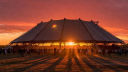
The epicenter of Roskilde is the legendary Orange Stage (Orange Scene), originally purchased from The Rolling Stones' 1976 European tour. Today, this iconic fabric canopy hosts headline crowds of over 85,000 spectators. However, the festival's spatial genius resides in its intimate experimental stages:
- Avalon: A massive timber-framed tent dedicated to roots, world music, folk, and ambient soundscapes.
- Apollo: An audiovisual laboratory for electronic explorers, featuring immersive LED architectures and localized spatial sound arrays.
- Gloria: An intimate indoor darkroom focused on extreme sonic experiments, modern classical crossovers, and spoken word.
- Arena: The cathedral of indie rock and hip-hop, second only to the Orange Stage in physical scale.
The 8-Day City: 'Warm-Up' Days and Dream City
Roskilde is celebrated for its unique 8-day format. The first four days ('The Warm-Up') are dedicated entirely to community campsites, self-built architectures in the Dream City district, skate ramps, street parties, and the First Days music schedule spotlighting emerging Scandinavian and Nordic artists before the main arenas open.
Sustainability & Resource Circularity
The festival operates its own material sort facility on-site. Over 90% of the food served across hundreds of food vendors is certified organic, and single-use plastics have been completely abolished in favor of washed, multi-use deposit cups that circulate tens of thousands of times across the event week.